Green roofs and façades – creating habitats, protecting the climate
Green roofs and façades provide significant benefits to biodiversity, climate protection, and building efficiency. Simple green roofs with sedum plants are low‑maintenance and provide a valuable habitat for insects, while more diverse plantings with herbs and shrubs can create richer and more valuable biotopes.
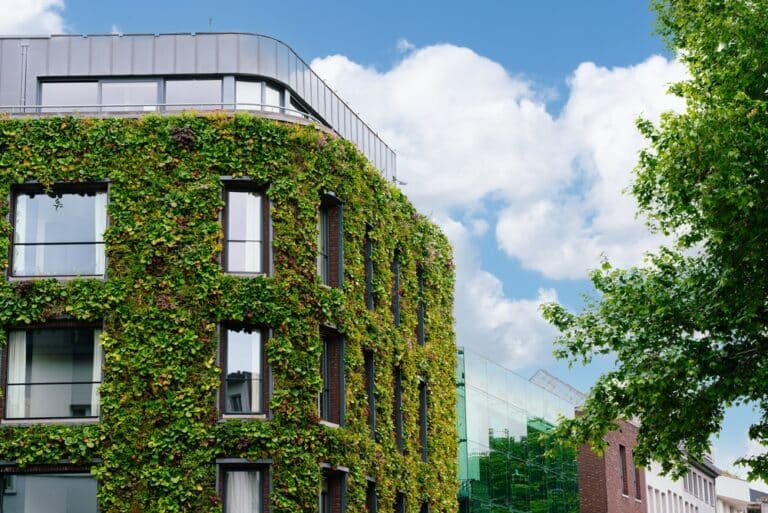
Green façades deliver comparable environmental benefits including cooling buildings through evaporation, storing CO₂, filtering fine particles, and enhancing the local microclimate.
In addition to ecological benefits, green areas also provide economic advantages: they extend the lifespan of roof membranes, increase building efficiency through additional thermal insulation, and can be combined with solar installations.
Green buildings are generally also perceived as more attractive, healthier, and modern, offering added value for employees. When combined with rainwater retention measures, green roofs also contribute to reducing flood risks.
The following article outlines the key steps to consider during planning and implementation.
Analysis of objectives and requirements
What are my specific objectives: improving energy efficiency, enhancing biodiversity, managing rainwater, or increasing the quality of outdoor spaces?
Which roof areas or façade sections on the site are available for vegetation / greening?
Identification of potential solutions and feasibility study
Green Roof
Conduct a structural assessment of the selected roof sections: www.oai.lu
Choose between extensive or intensive greening, potentially in combination with rainwater retention or a solar installation
Consider multifunctional solutions (roof garden, solar roof)
Cost and feasibility assessment prior to the start of the project
Please note: In addition to structural feasibility, the proposed measures may involve other considerable costs. Evaluate these aspects in advance and seek advice from a qualified specialist company if necessary.
Green façade
Perform a structural assessment of the relevant façade section
Is there a possibility for ground-based planting? (see info box)
Ground based green façade
Ground based means that the plants are rooted in the soil in front of the façade, providing a natural water and nutrient source, thereby lowering the dependency on an irrigation system. Advantages of ground based systems:
Reduce need for maintenance and lower operating costs.
Supports greater plant diversity, more robust species, and longer plant lifespans.
A distinction is made between self climbing plants (“self climbers”) and plants that require a support structure (“framework climbers”).
Beratung, Unterstützung und Beantragung möglicher Beihilfen
Kontaktieren Sie lokale oder nationale Institutionen, die Sie fachlich beraten können
Ecological service of your municipality
Nature Park or nature conservation syndicate (map.geoportail)
Klimabonus (for combined solutions with photovoltaic systems)
Special subsidy in the City of Luxembourg: Grant for residential buildings up to 40 €/m² (vdl.lu)
Project implementation
Due to technical requirements, the implementation can only be carried out by specialised companies.
source: www.biodiversiteetbati.fr/
source: GRÜNSTATTGRAU GmbH
Follow-up
Observe and document flowering periods as well as the development of biodiversity with photos, and communicate your biotope’s achievements both internally (employees) and externally (customers, municipality).
For sedum‑based green roofs, an annual inspection should be carried out to prevent vegetation from spreading to the roof edges. For roofs planted with herbs, grasses, perennials or shrubs, inspections and pruning should be carried out several times per year. All mowing and pruning material should always be removed from the roof


 Administration
 Agriculture, viticulture
 Aid and care sector
 Commerce
 Craft Industry
 Manufacturing