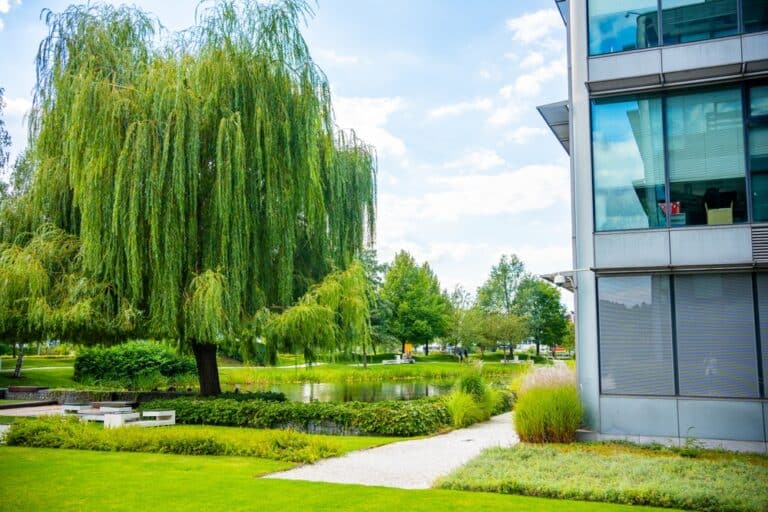
Nature-oriented design and management of green spaces
Environment
Administration
Agriculture, viticulture
Aid and care sector
Commerce
Craft Industry
Manufacturing
Last update: 27/05/2026
Outil disponible
Possibilité d’accompagnement
Subvention disponible
Nature-oriented green spaces – a valuable contribution to biodiversity
Green spaces on company premises are not only an aesthetic feature but can also serve as a strategic asset: they support sustainability goals, enhance employee well-being, and strengthen the company’s public image.
Unused open spaces are typically managed through routine maintenance tasks such as mowing lawns or trimming hedges and trees. As a result, their potential to deliver substantial biodiversity benefits is frequently overlooked. Through nature‑oriented redesign, these areas can be transformed into valuable habitats for insects, birds, and small mammals while requiring considerably less maintenance. This lowers costs and strengthens the company’s ecological profile.
Ecologically designed outdoor spaces also improve the microclimate, promote soil fertility, and create attractive recreational areas for employees and visitors.
The following sections outline the key steps to consider during planning and implementation.
Analysis of goals, needs, and an inventory of areas with potential for nature oriented design
What are my specific objectives? Is the goal to highlight the company’s ecological profile, create high quality outdoor spaces for employees, or improve the on-site microclimate and biodiversity?
Which outdoor areas are generally available for potential redesign?
Which areas are suitable for ecological improvement (e.g., lawns, conventionally designed flowerbeds, unused courtyards), and how have they been managed thus far?
Identifying potential solutions
Clarify whether the redesign could be carried out internally with employees (e.g., as a team building activity or nature based experience), or whether it is preferable to hire a qualified contractor.
Feasibility and cost evaluation prior to project implementation
Note: Determine the feasibility of planting trees and hedges in areas where underground utilities may be present. Depending on the existing infrastructure, root barrier systems or rhizome barriers might be necessary. If in doubt, refer to a qualified landscape gardener.
Support and advisory services for identifying and applying for funding opportunities
Contact local or national institutions that can provide you with professional advice.
The municipal ecological service
Nature Park or nature conservation syndicate(map.geoportail)
PACTE NATURE – cooperation with the local municipality is possible!
If your local municipality is participating in the PACTE NATURE programme, you can collaborate with them to implement measures on your company premises that also contribute to the municipality’s goals. These measures include plantings that contribute to the PACTE NATURE objectives and the provision of nesting opportunities for wildlife (Measures supporting wildlife). Contact your municipality’s PACTE NATURE advisor for further information.
Implementing the project
Small to medium projects – internal implementation
When creating new planting areas, exclusively use native plant material or appropriate seed mixtures. Locally adapted species (including native herbs, shrubs, and trees) require less water, do not require fertilisation, and provide significant ecological benefits for native wildlife.
Maximise habitat diversity: A structurally diverse design promotes the creation of numerous high‑quality habitats capable of supporting a broad spectrum of species. Use regional natural materials wherever possible.
Provide a year‑round supply of flowers and/or fruit and allow last season’s wild perennials to remain standing through winter. This helps insects find overwintering shelter and offers birds an important food source in winter.
Complement your plantings with bird nest boxes, bat roosts, and/or water sources for birds. (Measures supporting wildlifes).
Consider the potential maintenance requirements of the planned elements.
Verify the relevant legal requirements (e.g., regulations on avoiding invasive species).
Establish a management plan that includes a seasonal mowing regime, avoids the use of pesticides and ensures long term upkeep.
For tasks that are beyond in‑house capacity, obtain cost estimates from professional gardeners, including activities such as tree planting.
Explore funding opportunities or support from local conservation syndicates, nature parks, or the municipality.
Large projects
Obtain cost estimates from qualified landscape planning offices, gardeners, or horticultural companies.
Explore funding opportunities or support from local conservation syndicates, nature parks, or the municipality.
Follow up
Document the new maintenance requirements and the associated costs as part of a before‑and‑after evaluation.
Use photographs to record flowering periods and track the development of biodiversity. Communicate the achievements of your ‘stepping‑stone habitat’ internally (to staff) and externally (to customers and the municipality).


 Administration
 Agriculture, viticulture
 Aid and care sector
 Commerce
 Craft Industry
 Manufacturing