Corporate responsibility for nature: creating wildlife friendly company premises
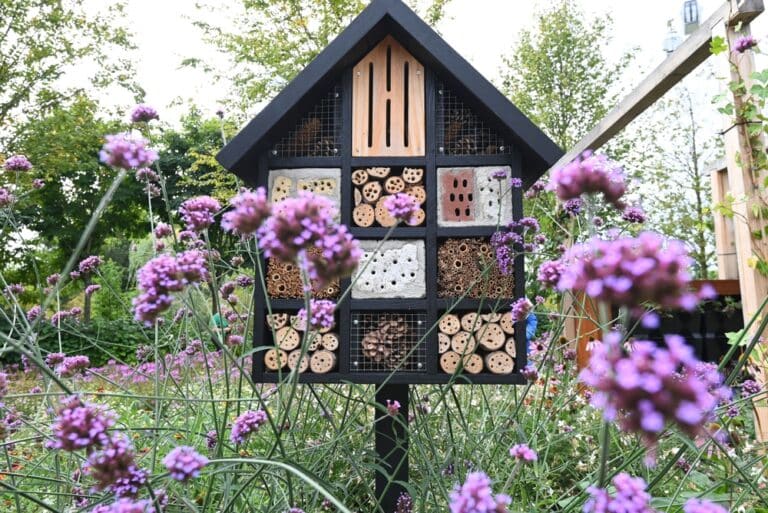
Company premises provide various opportunities to establish habitats for wildlife. Measures such as installing bird and bat boxes, placing insect hotels, or creating stone piles, deadwood areas, or small ponds require relatively little effort, but can contribute to structurally diverse habitats. Such additions complement any existing nature‑oriented landscaping (Mesure Nature-oriented design and management of green spaces) and significantly increase local biodiversity.
Not only do these measures contribute to species conservation, but they also improve ecological connectivity within urban areas by creating additional habitat structures (‘stepping‑stone biotopes’). Measures that are adapted to local site conditions and to the specific requirements of the local fauna are particularly effective.
Wildlife‑supporting initiatives provide additional advantages: they strengthen the company’s public image, improve customer perception, and increase the employees’ sense of identification with their workplace. The following article outlines the key steps to consider during planning and implementation.
Assessment of objectives and requirements, and identification of areas with potential for wildlife‑friendly design
What are the specific objectives? Is the aim to improve conditions for a single species or species group, or to create a multifunctional stepping‑stone habitat?
Which areas of the company premises are generally available for the implementation of such measures?
Are there any animal species present at the site that could be supported?
Which nesting refuges and supports are best suited to the site characteristics?
Identification of potential solutions
Identify which species groups may potentially benefit (e.g., insects, birds, small mammals, bats) and determine their specific requirements.
Analyse existing site structures and assess their suitability for species of interest (e.g., walls, infiltration channels, earth walls).
Clarify whether the redesign could be carried out internally with employees (e.g., as a team building activity or nature-based experience), or whether it is preferable to hire a qualified contractor or consult an external adviser (e.g., nature conservation syndicate or the regional nature park).
How can the measures be integrated with the building structure or existing green areas?
Who will be responsible for monitoring and maintaining the measures?
Could it be of interest to cooperate with local nature conservation organisations?
Support and advice for identifying and applying for funding opportunities
Contact local or national institutions that can provide you with professional advice.
PACTE NATURE – Cooperation with the municipality is possible
If your local municipality is participating in the PACTE NATURE programme, you can collaborate with them to implement measures on your company premises that also contribute to the municipality’s goals. These measures include plantings that contribute to the PACTE NATURE objectives and the provision of nesting opportunities for wildlife. Contact your municipality’s PACTE NATURE advisor for further information.
Implementing the project
General advice
Most measures can be implemented in‑house, such as constructing and installing bird nesting boxes, providing water sources for birds, or setting up insect hotels. However, terrain modifications or construction work generally exceed internal capacities. In this case it is advisable to seek professional guidance and obtain cost estimates from qualified landscape planning offices, landscape gardeners, or horticultural businesses.
Key principles:
Provide the greatest possible diversity of habitat structures. A higher variety of features increases the number of ecological niches and the number of species that may settle on the site.
Use regional and natural materials.
Assess the necessary maintenance of the planned elements (e.g., cleaning of bird nesting boxes and bat roosts).
Birds
Not all nesting boxes are the same. Different species require different types, such as cavity nesters, semi cavity nesters, and open nesting species. Construction plans for boxes are available online.
Ensure correct installation. Nesting boxes should be oriented to the south or southeast and placed at an appropriate height.
Species nesting on buildings such as sparrows, swallows, and swifts, have specific requirements (naturemweltasbl.lu).
Complement nesting sites with adequate food sources. When planting new vegetation, ensure a year‑round supply of flowering and/or fruit‑bearing plants. Leave withered native perennials standing over winter to provide insect overwintering sites and, consequently, food for birds.
Consider whether space is available for water features or drinking points for birds.
Avoid hazards or obstacles that may pose a deadly risk to birds (see information box below).
Bats
Bat boxes can also be installed, including flat boxes and round boxes. In most cases, daytime roosts are sufficient.
During new construction or renovation, it is possible to incorporate integrated solutions directly into the building façade.
Ensure that fences allow passage for small mammals, such as hedgehogs, by raising the fence 15 cm above ground level or by using wider mesh sizes.
Provide suitable overwintering structures for hedgehogs, such as dedicated hedgehog boxes or undisturbed piles of leaves. Construction plans for boxes are available online.
Amphibians and reptiles benefit from water features and sun exposed areas. Stone piles offer shelter as well as overwintering opportunities.
Avoid hazards or obstacles that may pose a deadly risk to birds (see information box below).
Insects
Even small insect hotels can provide a suitable habitat, however they should be designed accordingly and combined with an adequate supply of flowering plants.
Most wild bees nest in the ground and require open, sandy soil patches. Where possible, create so‑called “sandarium,” potentially supplemented with upright wooden logs.
Species Protection on Company Premises – Avoiding Hazards and Obstacles for Wildlife
Species protection does not only involve creating new habitats; it is equally important to maintain and improve existing conditions:
Reduce the risk posed by glass surfaces, which can be fatal to birds, by using patterned films or external blinds.
Prevent trap effects in channels or shafts by installing covers or grids of suitable size.
Provide climbing supports or ramps in situations where hazardous structures cannot be avoided, such as drainage shafts or channel inlets.
Follow-up
Observe the new structures and document their actual use by the species they are intended to support.
Document the development of biodiversity with photos and communicate the successes of your “stepping stone biotope” internally (to employees) and externally (to customers, the municipality).


 Administration
 Agriculture, viticulture
 Aid and care sector
 Commerce
 Craft Industry
 Manufacturing