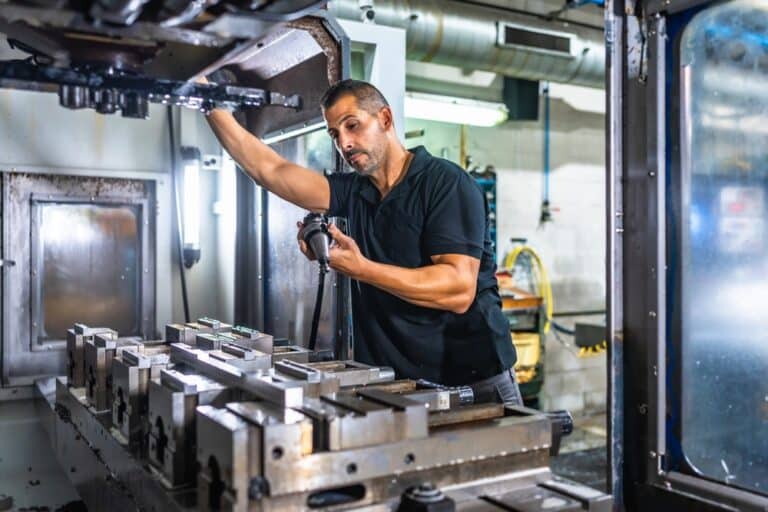
Mechanical workshop : Bending machines and press brakes driven by servo motor
Energy
Craft Industry
Manufacturing
Last update: 14/07/2026
Subvention disponible
Solutions innovantes
To make this measure more effective and tailored to the specific context of your company, we recommend that you first perform an overall analysis of your energy situation.
Remplacer une découpeuse laser CO2 par une découpeuse laser à fibre optique
This measure aims to replace a hydraulic bending machine or press brake operating with a three-phase asynchronous motor, with equivalent technology equipped with a servo motor. The hydraulic system runs continuously, even when the machine is not producing, resulting in significant and unnecessary energy consumption.
Implementing this measure can reduce electricity consumption by more than 30%. It is quite easy to carry out and does not require production shutdown. Although the technology is highly mature, energy cost savings alone may not always be sufficient for a return on investment. However, the lower the machine’s operating frequency, the greater the potential for energy and financial savings. It is therefore recommended to prioritise retrofitting machines with short operating times maximise return on investment.
A servo motor is a motor capable of accurately controlling rotary motion and maintaining a precise position. It can be used to drive different types of pistons, such as hydraulic, spindle or rocker pistons, allowing the equipment’s start-up and operation to be precisely adjusted according to actual needs.r.
Miscellaneous savings
For the machine equipped with a servo motor, financial savings are mainly achieved through significantly reduced electricity consumption, up to 70% compared to the baseline levels.
Apart from energy savings, a machine equipped with a servo motor offers several other advantages:
Precise movements and positioning
Lower maintenance needs thanks to optimised mechanics
Improved control over press speed and position
State subsidy application
State subsidies
Please note: any application for government or non-government subsidies must comply with the “incentive effect”, subject to compliance with the subsidy conditions. To ensure that the incentive effect of the aid is respected, no binding commitments may be made (acceptance of a quote; advance)
Aid for small and medium-sized companies, covering up to 70% of eligible costs for carrying out a project aimed at reducing their environmental impact. The total project cost must be between €3.000 and €25.000 excluding VAT.
The law of 8 December 2025 on the renewal of the aid scheme for environmental and climate protection provides for the granting of investment aid to SMEs and large companies established in Luxembourg, with a business licence, and carrying out projects that contribute to environmental or climate protection. This aid supports investments aimed at improving energy efficiency outside buildings. It is intended for initiatives that either reduce energy consumption by at least 20% or achieve energy savings of at least 250 MWh per year.
The following maximum rates apply:
Activity
Company size
Small
Medium
Large
Energy efficiency outside buildings
25 %
20 %
15 %
Maximum rates for aid under Article 7
When equipment is added to an existing installation and there is no counterfactual investment that is less environmentally friendly, the aid rate shown in the table above is doubled. SMEs may receive aid upon request if they meet the conditions set out in Article 7 of this law, provided that the aid is less than €100,000 and more than €50,000. Large enterprises, as well as SMEs, will also be able to participate in regular calls for projects, which will be announced below when they become available. The General Directorate – State Aid and Company Financing will verify the eligibility of applications.
For support or questions regarding the process, please contact Luxinnovation.
N.B. While several state subsidies cannot be granted for the same project, they can be combined with supplier subsidies.
Subsidies from electricity and natural gas suppliers
Since 2015, natural gas and electricity suppliers have been required to help consumers achieve energy savings as part of the obligation scheme.
Since then, energy suppliers have been offering support and advisory services, as well as subsidy programmes for consumers to implement energy efficiency measures.
The following suppliers offer this service to companies:
In 2026, enoprimes will celebrate its 10th anniversary. On this occasion, special incentives are being offered to businesses for any project initiated between 1 July and 31 December 2026, generating < 1,500 MWh of energy savings and not already benefiting from a preferential tariff scheme.
The tax relief is calculated based on the investments and operating expenses incurred as part of an ecological and energy transition project.
The tax relief rate is set at 18% and is applied directly to the amount of tax due.
This deduction can be combined with standard state subsidies.
For the project to be eligible, it must meet at least one of the following objectives:
Improve the energy efficiency of a production process
Improve the material efficiency of a production process
Decarbonise a production process
Reduce air pollution at the production site (excluding CO2 emissions)
Produce or store renewable energy for self-consumption
Promote the extended use of products through reuse
For certain objectives, minimum thresholds must be met.
To verify your eligibility and ensure that these thresholds are satisfied, it is recommended that the impact of the measure on one of the above conditions be certified by an expert or a design office.


 Craft Industry
 Manufacturing