To make this measure more effective and tailored to the specific context of your company, we recommend that you first perform an overall analysis of your energy situation.
Photovoltaics: an environmentally and financially interesting alternative for your company’s electricity production
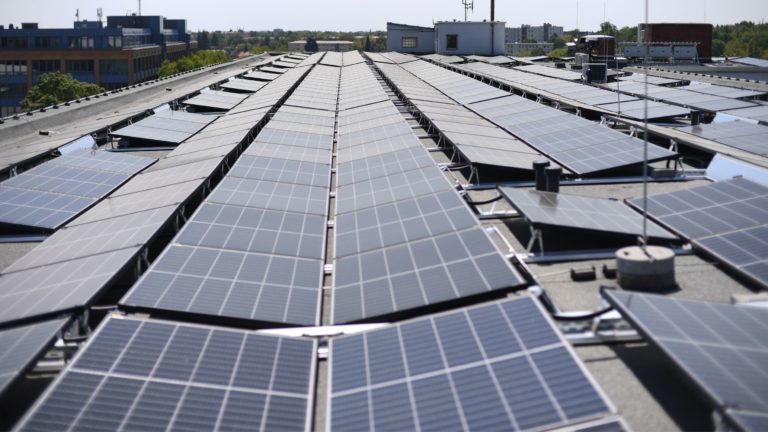
A photovoltaic installation enables a business to reduce the amount of electricity it draws from the grid. This lowers energy costs and limits exposure to fluctuations in the electricity market. Beyond self-consumption, there are other support mechanisms that can represent an interesting economic model, such as the guaranteed feed-in tariff or the market premium resulting from a call for tenders. The installation can be financed from your own funds or by a third-party investor, who can also take care of its planning and completion.
Definition of the requirements
Analysis of plant location and solar potential – solar cadastre
Analysis of the photovoltaic location, taking into account its orientation, tilt angle, potential shading, available installation area, and site-specific constraints.
Verification of the expected energy production potential using the solar cadastre.
This tool shows the annual global solar irradiation potential on your roof in kWh/m² per year.
To go further:
Load profile analysis and estimation of the self-consumption rate Use the LENEDA platform to analyse your electricity consumption profile based on your metering data to optimise the sizing of your photovoltaic system. By comparing your electricity consumption with the projected electricity generation of the installation, you can estimate your expected self-consumption rate.
Project implementation by a project developer / third-party investor For installations, it is possible to commission a photovoltaic project developer who can take care of the development, financing, construction, operation and maintenance of the installation.
Identify solution and check feasibility of photovoltaic panel installation project
General planning of the installation (depending on the scope of the project, in collaboration with a qualified craftsman or design office)
Connection feasibility: network operator. It is also important to reserve the required grid connection capacity with the grid operator, in accordance with the attached guidance note.
Where possible, combine the installation with an energy-efficient roof renovation or insulation upgrade
Possibility of including plant maintenance in the offer
Subsidy application
Government subsidies
Please note: any application for government or non-government subsidies must comply with the “incentive effect”, subject to compliance with the subsidy conditions. In order to respect the “incentive effect”, no binding commitment (signing a quotation; paying a deposit) may be made BEFORE having received the agreement in principle from the State or the electricity and natural gas supplier following an application for subsidy.
The operating aid enables companies to conclude a market premium contract for a period of at least 15 years. During this period, they receive remuneration based on the amount of electricity generated and fed into the grid.
This eighth call for tenders is open from 27 July to 30 October 2026 for a total capacity of 35 MW, divided into four lots. Depending on the lot, the maximum bid prices range from €80/MWh to €165/MWh.
Table 1: Overview of the different lots in the call for tenders for operating aid
As part of the competitive calls for tenders for photovoltaic projects, the government supports the deployment of large-scale photovoltaic installations through an investment subsidy. This financial support is intended to encourage companies to generate their own electricity.
This sixth call for tenders, launched by the Ministry of the Economy, is open from 17 July to 30 September 2026 and consists of three lots. Each lot includes sub-lots dedicated to photovoltaic installations equipped with energy storage systems. To be eligible for a “storage” sub-lot, the installation must have a minimum storage capacity of 1 kWh for every kWp of installed photovoltaic capacity.
Table 2: Overview of the lots under the investment aid call for tenders
Lot 1 :
Building rooftops; business park sites (ZAE)
30 kWp to 3 MWp
Lot 2 :
Innovative installations (rooftops with lightweight modules, façade-mounted modules)
30 kWp to 2 MWp
Lot 2 :
Solar canopies (carports)
30 kWp – 3 MWp
Different lots of the investment aid call for tenders
The Klimabonus state subsidy scheme is available to both legal entities and individuals. However, pre-financing is not available to legal entities whose activities are subject to a business permit. These entities must follow the standard procedure and apply to the Environment Agency (AEV) after the work has been completed.
The subsidy rate for a photovoltaic installation is calculated based on the power of the system, using the following formula:
PPV * (1.155 – (1.155 / 35) * PPV) €
PPV: peak electrical power of the photovoltaic solar installation concerned, expressed in kilowatt-peak (kWp) and rounded to two decimal places.
This scheme does not impose any limit on the peak power of the installation. However, a ceiling of €10,000 per installation applies for systems with a capacity of 15 kWp or more. The minimum eligible capacity is 2 kWp.
The tax relief is calculated based on the investments and operating expenses incurred as part of an ecological and energy transition project.
The tax relief rate is set at 18% and is applied directly to the amount of tax due.
This deduction can be combined with standard state subsidies.
For the project to be eligible, it must meet at least one of the following objectives:
Improve the energy efficiency of a production process
Improve the material efficiency of a production process
Decarbonise a production process
Reduce air pollution at the production site (excluding CO2 emissions)
Produce or store renewable energy for self-consumption
Promote the extended use of products through reuse
For certain objectives, minimum thresholds must be met.
To verify your eligibility and ensure that these thresholds are satisfied, it is recommended that the impact of the measure on one of the above conditions be certified by an expert or a design office.
This type of project may be eligible for tax relief, subject to compliance with the criteria set out in Article 152bis L.I.R.
Applying for permits
Don’t forget to check and obtain the permits required for the implementation of your photovoltaic project. To find out which procedures and permits may apply to your project, please consult the Procedures Manual.
After the installation of photovoltaic panels
In case of self-consumption: submitting the application for self-consumption to the grid operator
For the surplus electricity to be injected: sign an electricity buy-back contract at the market price with a supplier
If participating in a call for tenders with investment aid: submit the request for payment of the aid via the tool on MyGuichet.lu.
Apply for remuneration for the electricity produced by the photovoltaic system, depending on the specific situation:
Guaranteed feed-in tariff under the Klimabonus subsidy scheme (< 30 kWp) with the grid operator
Feed-in tariff without investment aid from the grid operator for installations > 30 kWp and < 400 kWp. From an installed capacity of 200 kWp onwards, membership in an energy cooperative may be required
Market premium with or without a call for tenders for photovoltaic installations from 400 kWp to 10 MWp with the grid operator and conclusion of a contract for the direct sale of the electricity with an agent who is normally a supplier.
The subsidy must be applied for after the installation has been completed, unlike other subsidies, where applications for subsidies must be made in advance of the commitment to carry out the project via MyGuichet.


 Administration
 Agriculture, viticulture
 Aid and care sector
 Commerce
 Craft Industry
 Manufacturing
 Transport